

Breakthrough in Aerospace and Vehicle Components
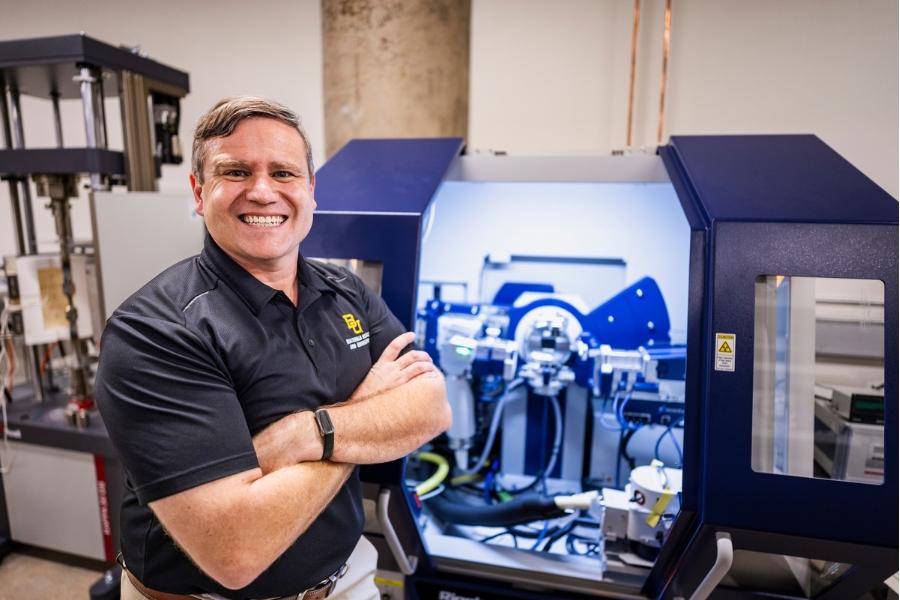
David Jack, Ph.D., professor and graduate program director for the Materials Science and Engineering program at Baylor, highlights equipment inside the Baylor Research and Innovation Collaborative, a 330,000-square-foot research facility.
The companies that make airplanes and automobiles are constantly searching for the next generation of technologies to bring their products to the market more efficiently, sustainably and inexpensively. While those goals are a driver for many industries, for aerospace and automobiles, they come with an overriding caveat — they must keep pilots, drivers and passengers safe while doing so.
In Baylor researchers and students, companies like Lockheed Martin, Volkswagen and others have found innovators who meet those rigorous standards.
David Jack, Ph.D., professor of mechanical engineering and graduate program director of materials science and Engineering, is a nationally recognized researcher in composite materials. Alongside his students in Baylor’s Scientific Innovations in Complex Engineering Materials research group, his team is driving advancements in non-destructive testing methods, polymer use and more.
“What we’re doing matters because these companies are building things that have to work the first time, every time. In aerospace, a single flaw can mean catastrophic failure,” Jack said. “Our job is to take the variability out of new materials, manufacturing methods and processes, to make them predictable, inspectable, and scalable.”
Mature 3D Printed Material Safety for Airplane Use
Centuries of usage, trial and error, and best-practice development have built a level of certainty in parts made by machining. As a newer technology, 3D printing lacks that precise and consistent process control. For airplane manufacturers who want to use these accessible materials to make parts, that variability presents a problem.
“The world has been doing metalworking for centuries, and aerospace has become very good in the last half-century of using this. It’s well-established,” Jack said. “For 3D printing, there remains part-to-part variability because we’re still learning. From an aerospace perspective, there’s really only been a little over a decade of use of 3D printed components.”
To accelerate manufacturers’ ability to trust the integrity of the process, Jack is developing an innovative acoustic wave-based process to inspect these parts and ensure their safety for use. Concurrently, he and his students build devices that allow that inspection to take place at production speed to avoid manufacturing bottlenecks that may arise for a variety of reasons — including the challenges associated with inspecting complex, axisymmetric shaped materials.
“Anything that’s a rotating shaft of some kind has an axisymmetric shape. If you imagine an
airplane, you have rotating, moving components everywhere, especially the engines. If you’re in the rotorcraft world, failure of rotating components can be catastrophic.”
Development of the acoustic-based inspection system both provides certainty in the analysis of the part’s fitness for use, while potentially reducing characterization time by a factor of 10 or more.
“It’s all about getting to an answer — is this product good, or is it bad?” Jack asks through this process. “We’re getting there by generating acoustic waves and utilizing the reflections that bounce off the different places inside the part. That allows us to generate 3D models and get that answer.”
Jack highlights the work of graduate students Savannah Rose and Rachel von Lear on the
Lockheed project, and an invention disclosure has been filed on the work. With seven major projects currently in process, Jack’s students are privy to no shortage of opportunities to learn and grow as they innovate for real-world applications in aerospace — and automobiles.
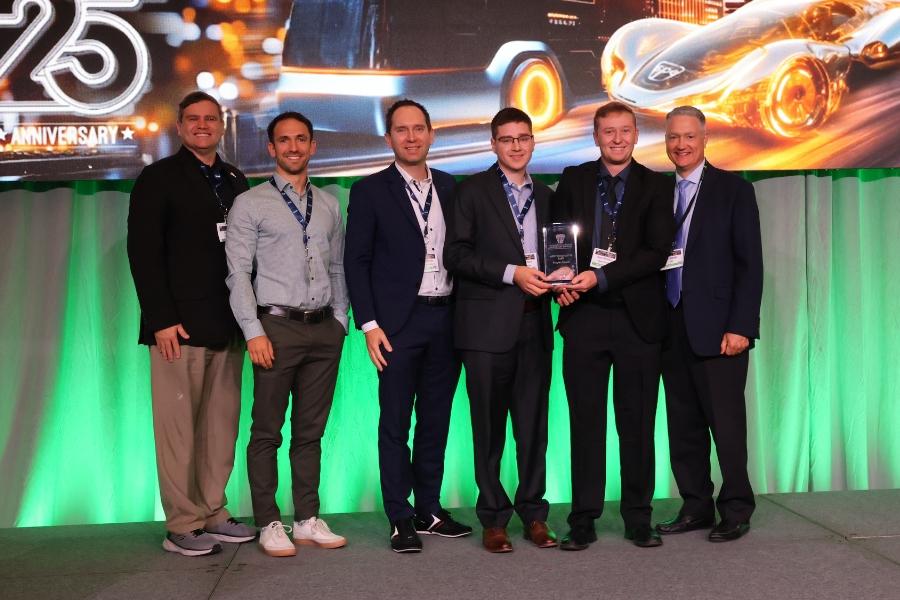
At the 2025 Automotive Composites Conference and Exhibition, Ryan Hatmaker and Clayton Hearn earned first place in the parts competition, receiving the people's choice award for their part, "Volkswagen ID.4 Interior Door Handle Bezel." This part was made as part of a joint effort with Volkswagen funded by IACMI.
Pictured from left to right: David Jack, Ph.D. – Baylor and ACCE Conference co-Chair; Marton Kardos – Volkswagen North America Group; Hendrik Mainka – Volkswagen North America Group; Clayton Hearn – Baylor; Ryan Hatmaker – Baylor; and Mike Siwajek – CSP and ACCE Conference co-Chair. Others from Baylor involved in the project are: Ryan Kinser, Jacob Hoarston, Ph.D., Brian Jordon, Ph.D., and Paul Allison, Ph.D.
Award-Winning Volkswagen Innovation
While aerospace research demands precision and speed, Jack’s work with Volkswagen
showcases sustainability and rapid prototyping. Most cities that house a manufacturer have a paper-producing facility in town or close by. What if their paper waste had an application for car parts? The Volkswagen North American Group has found that it does, in tandem with polypropylene. Jack and his team are working in partnership with Volkswagen to improve the process so that automotive-grade components can be produced.
Door bezels are something drivers see every day but give little thought. The casing around the door handle inside the car, door bezels deliver more complexity than most would consider, both in shape and scope — many span an entire car door. Two of Jack’s doctoral students, Ryan Hatmaker and Clayton Hearn, made a door bezel out of paper waste and polypropylene, and had to do so quickly.
“We submitted a project to enter in the Best in Show competition at the Automotive Composite Conference,” Jack said. “We were honored to be one of 13 entries, and competing with 12 professional part fabricators, like General Motors, CSP, and other Tier 1 part suppliers for the automotive industry. We had two months to make it happen. And we got first place.”
The challenge was formidable. Paper decomposes at the melting temperature of the polymer, making it difficult to mold without burning. To build a product, they had to devise a precise process. Working in partnership with Baylor’s Point-of-Need Innovations (PONI) Lab and Jacob Hoarston, M.S.M.E. ’24, Ph.D. ’25, a PONI staff scientist, they got to work on the tooling to make the composite part. Even a few degrees of temperature variation within the tool would burn the paper. In the process, things were set on fire (“Safely,” Jack pointed out). Through trial and error, they succeeded, winning top prize in front of leading experts in their field.
It's that type of problem-solving, innovation and student development that drives Jack, no matter the project.
“I love the concept that, together, we’re taking what we discover in God’s creation and how it is made, and we’re using that knowledge to build things we can utilize to keep people safe,” Jack said. “Seeing the students connect the dots while they learn is invigorating, and then to see them transition to great jobs and doing something exciting is one of the best jobs a person can have. This all supports the mission of this University, to educate men and women for worldwide leadership and service, and that’s motivates us every day.”
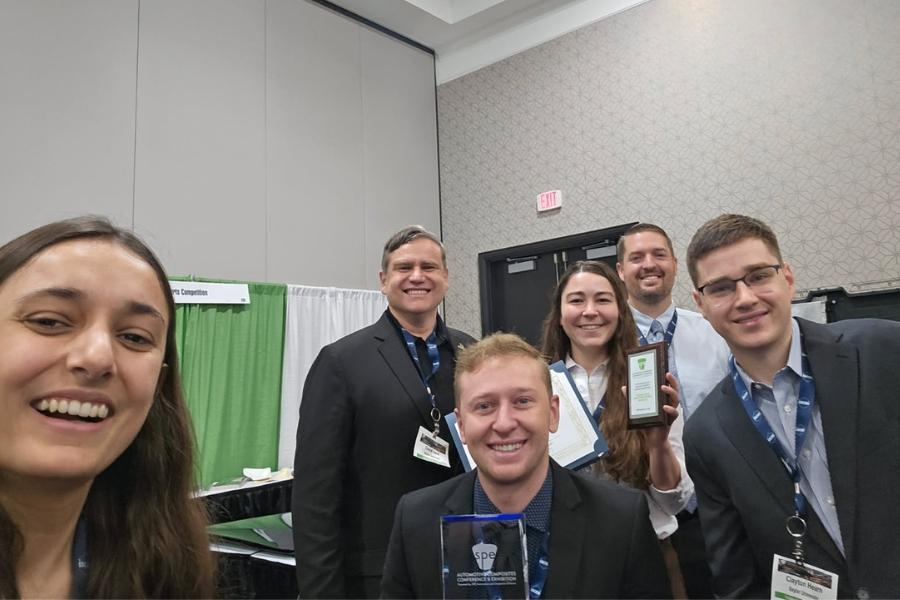
At the 2025 Automotive Composites Conference and Exhibition, graduate students Gabriela Meriano and Rachel Van Lear received the 2nd and 3rd place poster awards from over 25 student researchers. Also pictured are: David Jack, Ph.D., Ryan Hatmaker, Blake Heller, and Clayton Hearn.